

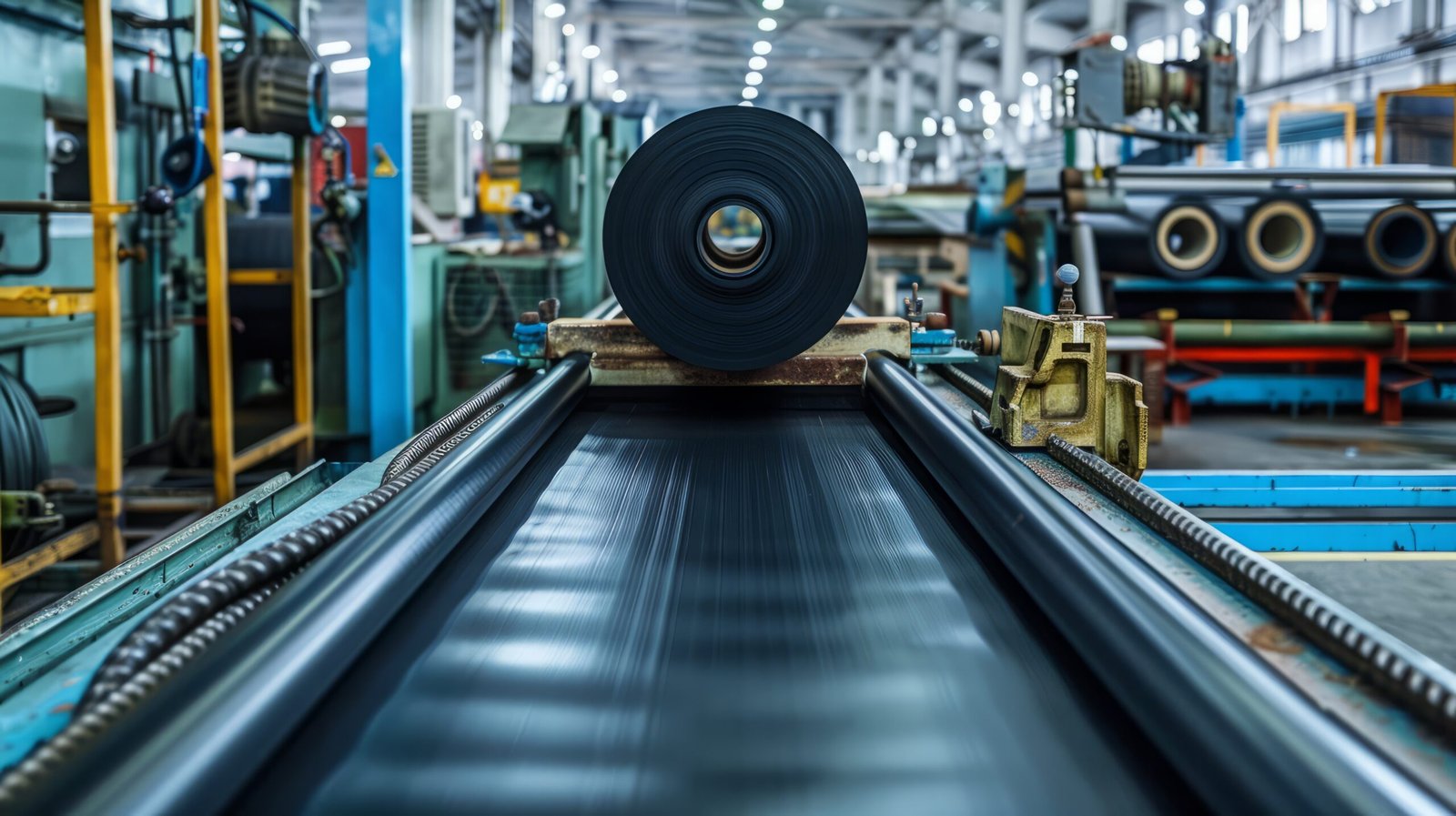
Bulk material transfer zones in coal handling plants, cement works, and mineral processing facilities face continuous operational challenges from spillage, fugitive dust, and belt abrasion. When ore or clinker drops onto a moving belt, the impact turbulence forces fine particles outward. Installing engineered conveyor skirt rubber creates a continuous physical barrier along the loading chute, confining bulk materials and preventing edge leakage.
Specifying inappropriate conveyor skirting rubber accelerates top-cover wear, increases motor drag, and creates costly material losses that run into lakhs of rupees annually. Achieving a reliable, dust-tight seal requires matching elastomer thickness, Shore A hardness, and profile geometry to chute velocity, lump size, and belt profile.
The Engineering Role of Skirt Board Rubber at Transfer Points
At conveyor transfer points, material discharges from the feed chute at varying drop heights, generating lateral outward pressure against the skirtboard walls. Skirtboard rubber serves as the flexible dynamic interface between the stationary steel chute and the moving conveyor belt.
Unlike rigid steel liners that must maintain a clearance of at least 25 mm above the belt to avoid direct gouging, elastomeric skirt rubber rests lightly on the belt surface. A well-engineered skirting arrangement performs three key functions:
- Seals the transfer trough against airborne dust and fine material escape.
- Accommodates vertical belt sag between impact idlers without breaking seal contact.
- Protects the conveyor top cover from grooving caused by trapped abrasive fines.
If the skirt rubber is too stiff, over-clamped, or improperly positioned, fugitive aggregate lodges between the seal and the belt, acting as a cutting tool that damages the conveyor cover.
Key Selection Parameters for Conveyor Belt Skirting
Selecting the proper grade and profile of conveyor belt skirting requires evaluating mechanical properties alongside material flow dynamics:
1. Elastomer Hardness (Shore A)
Hardness determines the balance between seal conformity and abrasive resistance:
- 55 to 65 Shore A: The standard specification for dry fines, limestone, coal, and clinker. This softer compound flexes over belt surface irregularities, maintaining a dust-tight seal without causing abrasive wear on the belt top cover.
- 65 to 75 Shore A: Recommended for secondary sealing strips or high-impact chutes conveying large lump ore (exceeding 75 mm), where extra stiffness is required to resist outward hydrostatic push.
- Skirt rubber should always maintain a lower Shore A hardness than the conveyor belt top cover (typically 60 to 70 Shore A) to ensure that the replaceable skirt strip wears out first, protecting the belt.
2. Rubber Thickness and Height
Skirt strip thickness determines structural resistance to lateral material pressure:
- 10 mm to 12 mm: Suitable for light to medium duty conveyors handling materials such as sand, fly ash, and grain.
- 15 mm to 20 mm: The standard industrial range for primary transfer zones in cement mills, thermal power stations, and iron ore handling plants.
- 25 mm and above: Heavy-duty applications carrying high lump volumes, high belt speeds (above 3.5 m/s), or steep trough angles.
3. Compound Polymer and Tensile Properties
Standard natural rubber (NR) and styrene-butadiene rubber (SBR) blends provide high tensile strength (minimum 10 to 14 MPa) and abrasion resistance for ambient materials. Where clinker temperatures exceed 100°C, heat-resistant EPDM compounds are required. In fuel handling facilities where tramp oil or lubricants are present, oil-resistant nitrile (NBR) polymers prevent seal swelling and softening.
Technical Comparison of Skirting Designs
| Sealing Configuration | Working Mechanism | Primary Application | Spillage Control Rating | Belt Wear Risk |
| Single Flat Strip | Solid rectangular rubber sheet clamped vertically | Light-duty aggregate and grain handling | Moderate | High if over-clamped |
| Bevelled-Edge Strip | 30 to 45 degree angle matching the belt trough | Medium-duty coal handling and crushing plants | Good | Low |
| Dual-Lip Dual-Seal Profile | Primary inner slab blocks bulk load; flexible outer flap seals fugitive dust | Skirt rubber for mining and cement plants | Excellent | Very Low |
| Polyurethane-Capped Composite | Low-friction PU wear face backed by flexible rubber | High-speed heavy mineral processing lines | Exceptional | Minimal |
Dual-Lip Sealing and Proper Installation Practices
Field failures in conveyor transfer zones rarely stem from the rubber compound alone; improper clamping and misalignment frequently compromise the seal.
Modern transfer zones increasingly specify dual-seal configurations. In this arrangement, a primary block stops the bulk lump pressure, while an extended, highly flexible secondary flap rests against the belt with light downward force to trap fine airborne dust.
To prevent premature belt damage:
- Never use discarded old conveyor belts as skirt rubber. Old carcass plies contain rigid textile or steel cords that rapidly score and cut the moving conveyor belt cover.
- Maintain a rigid backing steel plate with a minimum 25 mm gap above the belt to support the rubber against material surges.
- Install quick-release clamp systems that allow uniform pressure adjustment without overtightening individual fasteners.
Sourcing Industrial Skirting Solutions in India
For heavy industrial plants handling thousands of tonnes per hour, procuring skirts from experienced skirt rubber manufacturers in India guarantees consistent compound quality and dimensional accuracy.
Ameenji Rubber Limited manufactures high-grade industrial conveyor skirt rubber, elastomeric liners, and moulded sealing profiles formulated for demanding bulk handling installations. Backed by an in-house NABL-accredited testing laboratory, Ameenji rigorously tests compounds for tensile strength, elongation, Shore A hardness, and abrasion loss. All skirting solutions are supplied with batch test certificates, delivering predictable wear life and protecting high-value conveyor belts across mining, cement, and power infrastructure.