

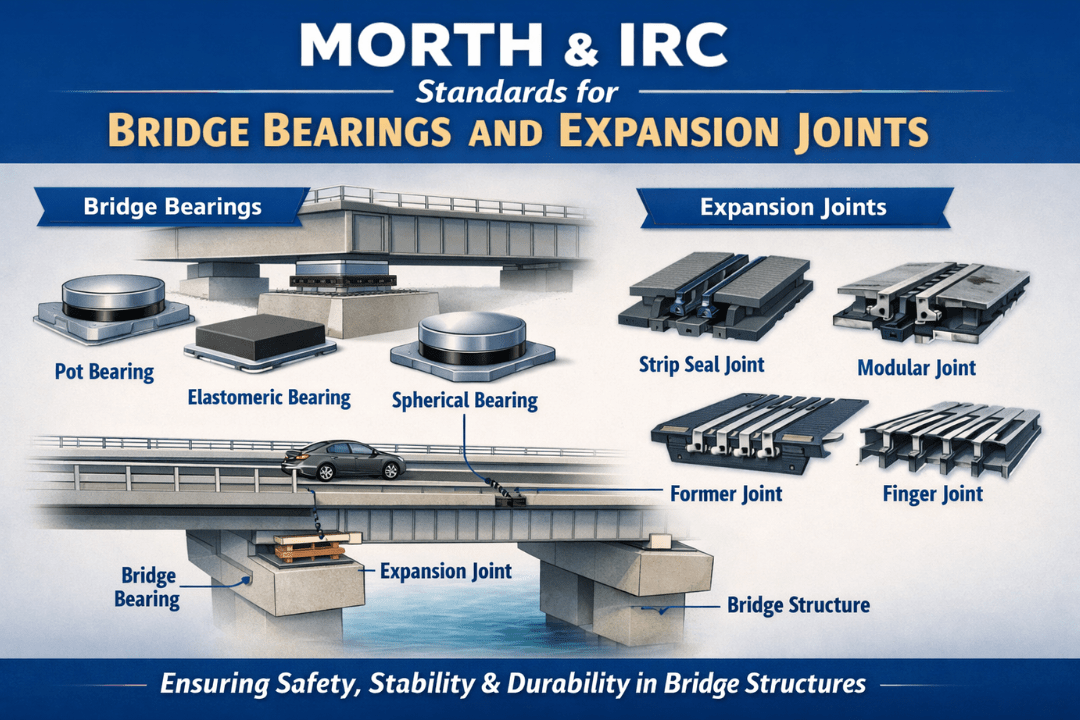
In India, bridge safety and longevity depend heavily on strict adherence to nationally prescribed standards. MORTH standards form the backbone of regulatory compliance, ensuring that critical structural components of bridge bearings perform reliably under diverse loading and environmental conditions.
Alongside MORTH, the Indian Roads Congress (IRC) provides detailed technical guidelines that govern the design, testing, and installation of bridge bearings and expansion joints. Together, these institutions define the framework that engineers, contractors, and authorities must follow for public infrastructure projects.
Understanding the Role of MORTH and IRC in Indian Bridge Construction
The Ministry of Road Transport and Highways (MORTH) is the apex government body responsible for formulating policies, specifications, and approval procedures for national highways and major road infrastructure in India. Its documents define mandatory government bridge specifications that apply to design, materials, testing, and execution.
The Indian Roads Congress (IRC) functions as a technical authority, issuing codes of practice, design manuals, and recommendations based on engineering research and field performance. Together, MORTH and IRC shape bridge construction regulations in India, influencing everything from material selection to final project certification.
MORTH Standards for Bridge Bearings Explained
MORTH standards for bridge bearings define the minimum performance, testing, and approval requirements for bearings used in highway and bridge projects. These standards ensure that bearings can safely transfer loads, accommodate movements, and perform consistently over their design life.
Compliance with MORTH is mandatory for:
- National highways
- State highways funded through central schemes
- Projects executed under EPC or HAM models
Only MORTH approved bridge components that meet prescribed specifications and testing criteria are permitted for use in these projects.
MORTH Approved Elastomeric Bearings and Their Applications
MORTH approved elastomeric bearings must meet defined criteria related to material properties, load capacity, deformation limits, and durability. Approval is typically based on compliance with IRC codes, supported by laboratory testing and manufacturer certification.
These bearings are commonly used in:
- Highway bridges
- Flyovers and ROBs
- Urban and semi-urban bridge structures
Their widespread adoption supports highway bridge compliance in India, provided installation and testing procedures strictly follow approved standards.
IRC Bridge Bearing Guidelines and Design Considerations
The IRC bridge bearing guidelines provide detailed direction on bearing design, addressing:
- Vertical and horizontal load transfer
- Rotational and translational movement accommodation
- Durability under cyclic loading
- Environmental and seismic considerations
IRC documents also specify bridge bearing testing requirements, ensuring that bearings perform as intended throughout the structure’s service life.
Bridge Bearing Testing Requirements Under Indian Standards
Both MORTH and IRC mandate comprehensive bridge bearing testing requirements before approval and deployment. These typically include:
- Compressive load testing
- Shear deformation and recovery tests
- Aging and ozone resistance tests
- Durability and fatigue checks
Such testing validates compliance with government bridge specifications and helps prevent premature failures caused by material degradation or improper design.
Standards for Bridge Expansion Joints in India
Bridge expansion joints accommodate movements caused by temperature variations, traffic loads, creep, and shrinkage. Adherence to standards for Bridge Expansion Joints in India is essential to prevent leakage, riding discomfort, and structural damage.
Indian standards define acceptable limits for:
- Movement capacity
- Sealing effectiveness
- Load resistance
- Durability under repeated cycles
These requirements are closely aligned with IRC standards for expansion joints.
IRC Expansion Joint Specifications and Performance Criteria
The IRC expansion joint specifications outline detailed requirements related to:
- Joint type selection
- Material performance
- Installation tolerances
- Drainage and sealing systems
By following these specifications, engineers reduce the risk of premature joint failure and lower long-term maintenance costs, while remaining compliant with bridge construction regulations in India.
Highway Bridge Compliance and Regulatory Approval Process
Achieving highway bridge compliance in India involves a structured approval process that includes:
- Submission of design calculations
- Material and component certifications
- Test reports from approved laboratories
- Inspection and verification during execution
Strict adherence to government bridge specifications ensures accountability, transparency, and quality assurance throughout the project lifecycle.
Common Compliance Mistakes and How to Avoid Them
Common regulatory issues include:
- Use of non-certified materials
- Incomplete or outdated test reports
- Improper installation practices
- Deviation from approved drawings
To avoid delays and rework, engineers and contractors must fully understand and comply with bridge construction regulations, conduct regular audits, and ensure accuracy in documentation.
Importance of MORTH and IRC Standards in Safe Bridge Infrastructure
Adherence to MORTH and IRC standards is essential for ensuring structural safety, durability, and regulatory approval of bridge projects across India. These frameworks establish uniform benchmarks for quality, performance, and accountability.
By following MORTH standards for bridge bearings and associated IRC guidelines, stakeholders ensure that bridge bearings and expansion joints perform reliably, protecting public infrastructure and enhancing long-term serviceability.
AUTHOR: Mr. Sasanam Srinivas Rao
ROLE: Assistant Manager/QA&QC

About The Author
Mr. Sasanam Srinivas Rao is the assistant manager QC who specializes in testing of bridge bearings and expansion joints at ameenji.